 |
|
Welcome to the research group DILiS
Data Integration in the Life Sciences (DILiS)
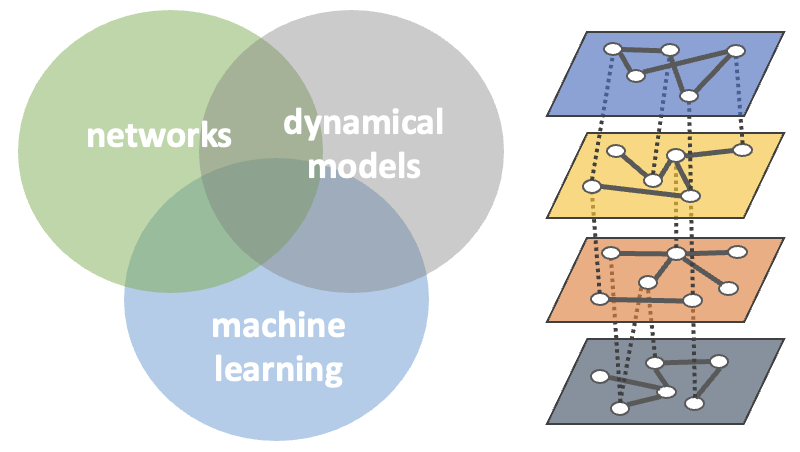 For many problems in the life sciences, different types of data have been generated and provide different views. Each data layer comes with its own limitations, errors and biases, so their integrative analysis is key for robust conclusions in order to understand complex phenomena. Our research group Data Integration in the Life Sciences (DILiS) leverages different methods for data analysis: machine learning enables the detection of patterns from unstructured data, but large deep learning models usually require large amounts of data. Networks allow representing interactions between entities and are highly informative. Straightforwardly, they enable the combined analysis of different data views. Dynamical models capture temporal behaviors and complex, intricate relationships. In addition to using these methods and their strengths separately, we are interested in combining machine learning, network-based analysis and mathematical modeling of dynamic processes. We are thereby especially interested in how the latter two can be used to include prior information (domain knowledge) into the prediction pipelines. Applications stem mainly from a biomedical background, such as drug response prediction, and we focus on integrating different kinds of data with biomolecular, "multi-omics" data.
Get to know our group
Latest News
September 27, 2026: AuditOwl
Our AuditOwl paper was published in TMLR and accepted to NeurIPS 2026. AuditOwl is an agentic AI tool that maps the claims in a manuscript to the code implementing them and checks whether the code supports them.September 23-25, 2026: RExPO26
Katharina Baum attended the RExPO26 conference in Berlin, where she presented our research on network-based drug response and drug combination prediction with multi-omics data.August 31, 2026: ECCB 2026
We attended ECCB 2026 in Geneva, where Umur Can Kaya presented our work on using universal differential equations to uncover the interaction between the NF-κB and p53 signaling pathways from single-cell data.GitHub
Visit our group GitHub to explore our latest open-source pipelines, software packages, and computational tools.Edit | Attach | Print version | History: r18 < r17 < r16 < r15 | Backlinks | View wiki text | Edit wiki text | More topic actions
Topic revision: r18 - 14 Oct 2026, Renka01UserTopic
 Copyright © by the contributing authors. All material on this collaboration platform is the property of the contributing authors.
 Ideas, requests, problems regarding Foswiki? Send feedback